
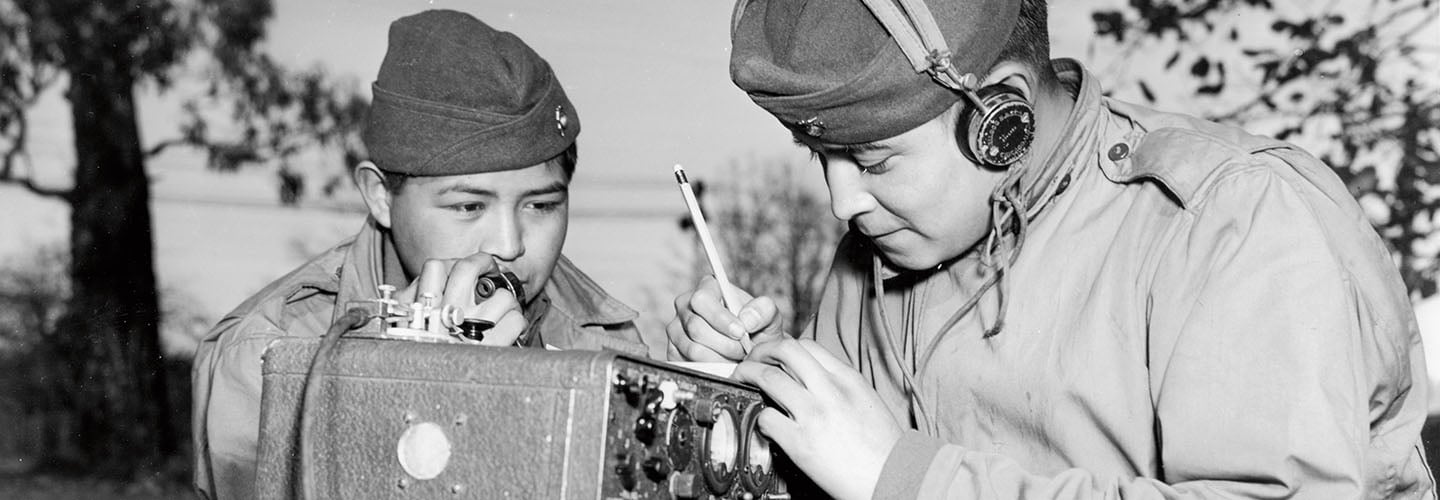

Historical photo of two soldiers in uniform, one speaks into a field radio as the other writes notes

Code talkers send secret messages over a radio during World War II.

U.S. NATIONAL ARCHIVES

Standards

Code Talkers

Navajo soldiers came up with a secret code that helped the United States win World War II.

Thomas Begay was scared. It was February 1945. Begay was in Japan during World War II (1939-1945). Planes were being shot out of the sky. There was smoke everywhere.

Begay had an important job to do. He was one of more than 400 Navajo code talkers. They used a secret code to help the U.S. win the war.

Thomas Begay was scared. It was February 1945. Begay was in Japan. World War II (1939-1945) was going on. Planes were being shot down. There was smoke everywhere.

Begay had a big job. He was one of more than 400 Navajo code talkers. They used a secret code. They helped the U.S. win the war.

The Code That Couldn't Be Broken
Watch a video to learn more about the Navajo code talkers.

A Secret Weapon

Begay is a member of the Navajo Nation. He grew up in New Mexico. His family spoke only the Navajo language. As a kid, Begay was sent to a school run by the U.S. government. Thousands of Native kids were forced to attend similar schools. They were banned from speaking their Native languages. But during World War II, the Navajo language would save countless lives.

On December 8, 1941, the U.S. entered the war. It would fight against Japan and other nations. Begay joined the U.S. military in 1943. He soon found out he was going to be a code talker.

Begay is a member of the Navajo Nation. He grew up in New Mexico. His family spoke only the Navajo language. As a kid, Begay was sent to a school run Navajo soldiers came up with a secret code that helped the United States win World War II. by the U.S. government. Thousands of Native kids had to go to schools like these. They were not allowed to speak Native languages. But during World War II, the Navajo language would save many lives.

On December 8, 1941, the U.S. entered the war. It was against Japan and other nations. Begay joined the U.S. military in 1943. He learned he would be a code talker.

Courtesy of Thomas H. Begay (Begay during WWII); Ross D. Franklin/AP Images (Begay today)

Thomas Begay during World War II and today

Back then, U.S. troops sent battle plans and other messages over radios. They spoke in code so the enemy couldn’t understand. But Japanese soldiers were skilled at deciphering codes. That put U.S. troops in danger.

So the military came up with a plan. They asked Navajo men to create a code based on their Native language. At the time, very few non-Navajo people spoke the language. Officials thought it would be perfect for a secret code.

A group of Navajo soldiers created the code. Then Begay and other Navajo men memorized it and added new code words. In February 1945, Begay used the code to send messages in battle in Japan.

Back then, U.S. troops sent battle plans over radios. They spoke in code. That way, the enemy couldn’t understand. But Japanese troops were good at deciphering codes. That put U.S. troops at risk.

So the military asked Navajo men to create a code. It would be based on their Native language. At the time, not many people spoke the language. Leaders thought it would be perfect for a secret code.

A group of Navajo soldiers made the code. Begay and other Navajo men memorized it. They added new words. In February 1945, Begay used the code. He sent messages in battle.

Honoring Heroes

Jim McMahon/Mapman®

Japan never cracked the code. In late 1945, the U.S. and its allies won the war.

For decades, the work of the Navajo code talkers was kept secret. The military didn’t want anyone to know about the code in case it was needed again. In 1968, the U.S. allowed the stories of these heroes to be told.

Begay is proud of his role in the war.

“I didn’t ask to be a code talker,” he says. “But I was a Navajo at a time when the United States needed Navajos.”

Japan never broke the code. In late 1945, the U.S. and its allies won the war.

For years, the work of the Navajo code talkers was a secret. The military didn’t want people to know about the code. They thought it might be needed again. But in 1968, the U.S. allowed the stories of these heroes to be told. Begay is proud of his role in the war.

“I didn’t ask to be a code talker,” he says. “But I was a Navajo at a time when the United States needed Navajos.”

All About the Navajo

The Navajo Nation has more than 427,000 members. It is one of the largest Native groups in the U.S.

The Navajo Nation has more than 427,000 members. It is one of the largest Native groups in the U.S.

Many Navajo people live on the group’s reservation. It stretches across parts of New Mexico, Arizona, and Utah.

Many Navajo people live on the group’s reservation. It stretches across parts of New Mexico, Arizona, and Utah.

The Navajo call themselves Diné. That means “the people.”

The Navajo call themselves Diné. That means “the people.”

1. According to the article, why did U.S. troops sometimes need to speak in code during World War II?

2. Based on the article, do you think the Navajo code talkers succeeded in their work? Explain.

3. Why did the U.S. military keep the work of the Navajo code talkers secret even after World War II ended?

1. According to the article, why did U.S. troops sometimes need to speak in code during World War II?

2. Based on the article, do you think the Navajo code talkers succeeded in their work? Explain.

3. Why did the U.S. military keep the work of the Navajo code talkers secret even after World War II ended?

videos (4)
videos (4)
videos (4)
videos (4)
Skills Sheets (3)
Skills Sheets (3)
Skills Sheets (3)
Games (1)
TEACHER SUPPORT (1)
Leveled Articles (1)
Text-to-Speech