

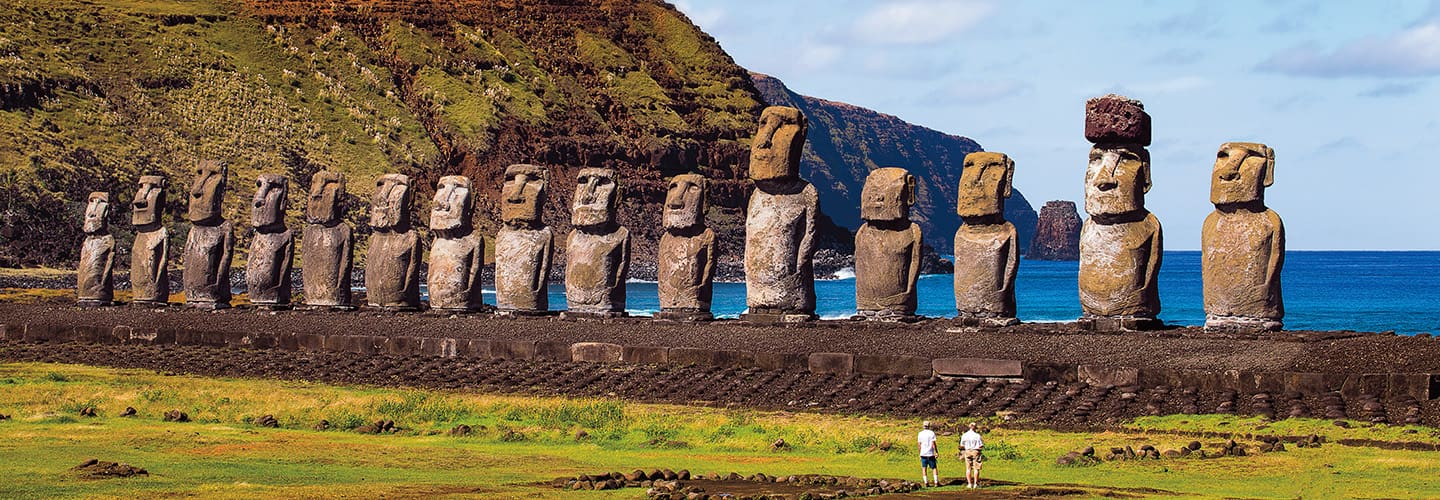

A row of moai statues on Easter Island with two people standing at their base

The tallest moai statue stands about 33 feet tall.

Chakarin Wattanamongkol/Getty Images

Standards

Mystery Solved?

A new study may explain how people moved huge stone statues hundreds of years ago.

Jim McMahon/Mapman® 

From far away, they look like giant guards. But they’re actually famous statues. More than 900 of them are on an island in the Pacific Ocean. It’s known as Easter Island. People who live there call it Rapa Nui (RAH-puh NOO-ee).

The towering stone statues were created between 400 and 900 years ago. They are called moai (MOH-eye). The islanders made the statues to honor some of their greatest leaders.

Workers carved the statues out of the walls of a volcano. Then they moved them across the rocky island. Some were transported as far as 11 miles.

But back then, the islanders didn’t have wheels. So they couldn’t have moved the statues on carts. The types of machines we use today didn’t exist at that time either. So how did workers move the statues? Some are more than 13 feet tall and weigh 28,000 pounds. That’s about as heavy as seven cars!

One idea is that workers laid the moai on wooden sleds. Then they rolled the statues over logs. But a new study supports a different idea. Some experts think the statues may have “walked.”

The Mysteries of Easter Island
Watch a video about mysterious statues carved hundreds of years ago on Easter Island.

Put to the Test

Researchers in the United States wanted to test that idea. They thought the islanders used ropes and their own strength, not sleds, to move the moai. So they set up an experiment.

First, the team built a life-sized model of a moai. Then they attached ropes to its head. A group of 18 people used the ropes to rock the model from side to side. This slowly moved the statue forward. It looked like the model was walking!

Carl Lipo

Researchers use ropes to “walk” the moai model forward.

A Smart Move

Scientist Carl Lipo was one of the leaders of the study. He says the fact that the islanders were able to move the statues was very impressive.

“It shows that the Rapa Nui people were incredibly smart. They figured this out,” Lipo says. “We have a lot to learn from them.”

1. Why did the people of Rapa Nui carve the moai statues?

2. How do scientists know that the people of Rapa Nui did not use machines on wheels to move the statues?

3. What does the author mean when she writes that the statues “may have walked”?

videos (2)
videos (2)
Skills Sheets (3)
Skills Sheets (3)
Skills Sheets (3)
Games (1)
TEACHER SUPPORT (1)
Text-to-Speech