

Ali Moustafa/Getty Images

Standards

Ancient Egypt Comes Alive

Thousands of items are on display in a new museum in Egypt.

As You Read, Think About: How can museums help us better understand the past?

Let’s Go to Egypt
Watch a video to learn more about this country in northeast Africa.

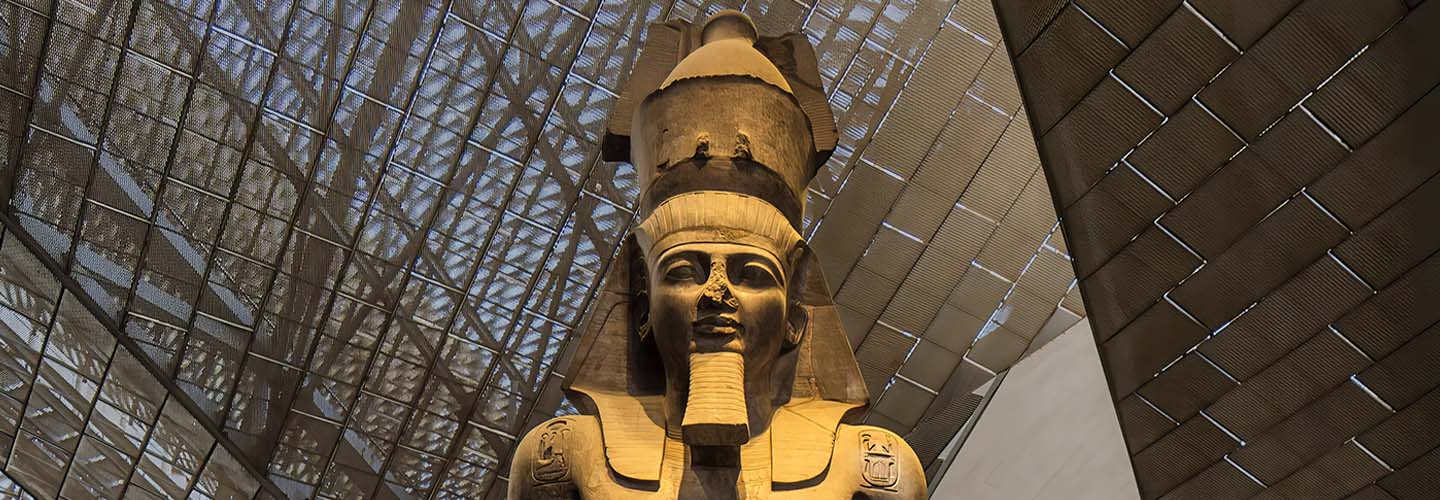
Imagine stepping into a new museum. You’re greeted by a huge statue of Ramses II. He was one of the most powerful rulers of ancient Egypt. Next you walk through rooms filled with giant wooden boats and sparkling gemstones. Then you come face-to-face with one of the most famous artifacts in the world. It’s the gold mask of King Tutankhamen (too-tahn-KAH-muhn). He’s better known as King Tut.

Welcome to the Grand Egyptian Museum. It opened last year in Egypt, a country in Africa. It’s the world’s largest museum focused on one civilization.

Imagine you are in a new museum. You see a huge statue of Ramses II. He was one of the most powerful rulers of ancient Egypt. Next you walk through some rooms. They’re filled with giant boats and sparkling gems. Then you come face-to-face with one of the world’s most famous artifacts. It’s the gold mask of King Tutankhamen (tootahn-KAH-muhn). He’s also called King Tut.

Welcome to the Grand Egyptian Museum. It opened last year in Egypt, a country in Africa. It’s the world’s largest museum focused on one civilization.

Ali Moustafa/Getty Images

This statue of Ramses II is about 36 feet tall.

Years in the Making

Egypt’s president announced plans for the museum in 1992. But turning it into a reality took decades. Construction finally began in 2005. The museum wasn’t finished until 2023. It covers more than 5 million square feet. That’s an area as big as about 90 football fields.

Building such a huge museum was one challenge. Filling it was another. The museum includes thousands of Egyptian artifacts (see “Treasures of the Past,” below). They were collected from other museums in Egypt and around the world.

Preparing the items to be displayed took a lot of time. All the artifacts are thousands of years old. Some were damaged. Experts spent years cleaning and repairing the pieces.

Egypt’s president revealed plans for the museum in 1992. But bringing it to life took decades. Construction began in 2005. The museum was finally done in 2023. It covers more than 5 million square feet. That’s an area as big as about 90 football fields.

Building a huge museum was one challenge. Filling it was another challenge. The museum includes thousands of Egyptian artifacts (see “Treasures of the Past,” below). They were gathered from other museums in Egypt and around the world.

Preparing the items for display took a lot of time. They are thousands of years old. Some were damaged. Experts spent years cleaning and repairing the pieces.

Treasures of the Past

More than 100,000 items can be found in the Grand Egyptian Museum. Here are a few.

More than 100,000 items can be found in the Grand Egyptian Museum. Here are a few.

 Berk Ozdemir/Alamy Stock Photo

This statue represents a sphinx. That’s a creature with the body of a lion and the head of a human.

This statue represents a sphinx. That’s a creature with the body of a lion and the head of a human.

Shutterstock.com

This small statue is believed to show Horus. He was the Egyptian god of the sun and the sky. Horus was often shown with the head of a falcon.

This small statue is believed to show Horus. He was the Egyptian god of the sun and the sky. Horus was often shown with the head of a falcon.

 Business Wire via Getty Images

Four mini versions of King Tut’s coffin were buried alongside him. Each held one of Tut’s organs (liver, lungs, stomach, or intestines) wrapped in linen.

Four mini versions of King Tut’s coffin were buried alongside him. Each held one of Tut’s organs (liver, lungs, stomach, or intestines) wrapped in linen.

Museum officials wanted to make sure each artifact tells a story. Visitors can learn about Egyptian gods. They can also find out how ancient Egyptians built pyramids long before modern machines existed.

“It’s not just putting lots of pretty things up,” says Salima Ikram. She’s an expert on ancient Egypt. “It’s what you come away learning from them.”

Museum officials made sure each artifact tells a story. Visitors can learn about Egyptian gods. They can also see how ancient Egyptians built pyramids before modern machines were used.

“It’s not just putting lots of pretty things up,” says Salima Ikram. She’s an expert on ancient Egypt. “It’s what you come away learning from them.”

Pause and Think

What were some challenges of bringing the museum to life?

What were some challenges of bringing the museum to life?

Uncovering History

Album/Alamy Stock Photo 

This golden throne once belonged to King Tut.

One collection is creating the biggest buzz: the King Tut exhibit. Tut is often called the Boy King. He became the pharaoh of Egypt about 3,400 years ago. He was just 8 or 9 years old at the time. Tut died about a decade later.

Ancient Egyptians believed in life after death. They preserved the bodies of their rulers as mummies. Pharaohs were buried with their belongings so they could use them in the afterlife. Tut was buried with his jewels, clothes, games, and other items.

Tut’s tomb was discovered in 1922. British scientist Howard Carter found it in a royal burial ground called the Valley of the Kings. Carter’s team spent 10 years carefully removing every item.

Today only Tut’s mummy remains in his tomb. Everything else is at the Grand Egyptian Museum. More than 5,500 items from Tut’s tomb are on display together for the first time.

Ikram says the museum is packed with history. Visitors can explore what interests them most—from kings to the lives of ordinary Egyptians.

“That’s what a museum visit should be, a personal journey of discovery,” Ikram explains.

One collection is creating the biggest buzz. It’s the King Tut exhibit. Tut is often called the Boy King. He became the pharaoh of Egypt about 3,400 years ago. He was just 8 or 9 years old then. Tut died about a decade later.

Ancient Egyptians believed in life after death. They preserved the bodies of their rulers as mummies. Pharaohs were buried with their things. This way, they could use them in the afterlife. Tut was buried with many items. These include his jewels, clothes, and games.

Tut’s tomb was found in 1922. British scientist Howard Carter found it in the Valley of the Kings. That’s a royal burial ground. Carter’s team spent 10 years taking out every item.

Today only Tut’s mummy is left in his tomb. Everything else is at the Grand Egyptian Museum. More than 5,500 items from the tomb are displayed. It’s the first time they’re shown together.

Ikram says the museum is filled with history. Visitors can see what interests them most. That includes everything from kings to the lives of everyday people.

“That’s what a museum visit should be, a personal journey of discovery,” Ikram says.

What's Up, World? Egypt

Life in Egypt dates back thousands of years. Today the African nation is home to about 115 million people.

Life in Egypt dates back thousands of years. Today the African nation is home to about 115 million people.

Jim McMahon/Mapman®

Shutterstock.com

A MIGHTY WATERWAY: Ancient Egyptians depended on the Nile River for food, water, and transportation. Most Egyptians today live within a few miles of it.

A MIGHTY WATERWAY: Ancient Egyptians depended on the Nile River for food, water, and transportation. Most Egyptians today live within a few miles of it.

Shutterstock.com

CRITTER CORNER: The deserts and mountains of Egypt are filled with animals. They include foxes, gazelles, and ibexes—a type of goat.

CRITTER CORNER: The deserts and mountains of Egypt are filled with animals. They include foxes, gazelles, and ibexes—a type of goat.

Shutterstock.com

GIANTS IN THE DESERT: The pyramids of Giza have towered over Egypt for about 4,500 years. They were built to honor Egyptian kings. Thousands of workers spent decades building them.

GIANTS IN THE DESERT: The pyramids of Giza have towered over Egypt for about 4,500 years. They were built to honor Egyptian kings. Thousands of workers spent decades building them.

1. What were some challenges involved in creating the Grand Egyptian Museum?

2. What kinds of things can visitors learn about ancient Egyptian civilization by visiting the Grand Egyptian Museum?

3. What does the author mean when she writes that the King Tut collection is creating the “biggest buzz"?

1. What were some challenges involved in creating the Grand Egyptian Museum?

2. What kinds of things can visitors learn about ancient Egyptian civilization by visiting the Grand Egyptian Museum?

3. What does the author mean when she writes that the King Tut collection is creating the “biggest buzz"?

videos (4)
videos (4)
videos (4)
videos (4)
Skills Sheets (3)
Skills Sheets (3)
Skills Sheets (3)
Games (1)
TEACHER SUPPORT (1)
Leveled Articles (1)
Text-to-Speech