

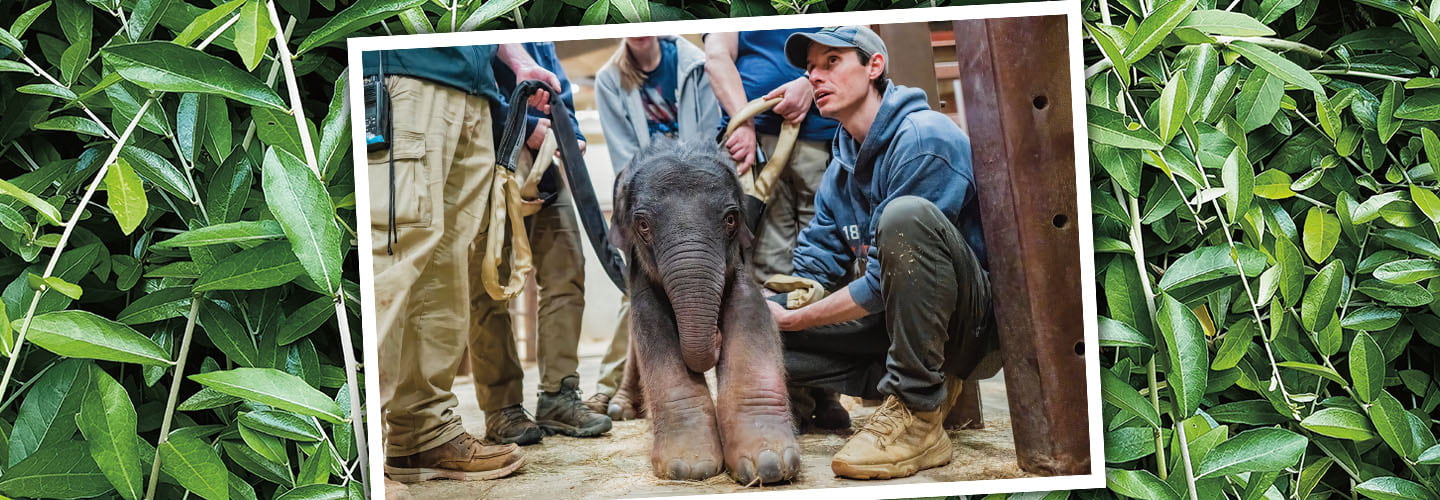

Shortly after her birth on February 2, zookeepers helped the calf take her first wobbly steps.

Roshan Patel, Smithsonian’s National Zoo & Conservation Biology Institute (Linh Mai); Shutterstock.com (background, all other images)

Standards

A Bundle of Hope

An Asian elephant was recently born at a zoo in Washington, D.C. Could she help save her species?

As You Read, Think About: Why was the elephant’s birth such big news?

Workers at the National Zoo in Washington, D.C., broke into cheers. It was early in the morning on February 2. A female Asian elephant had just been born. The calf weighed 308 pounds and stood about 3 feet tall. She was later named Linh Mai (lin my). That means “spirit blossom” in Vietnamese. (Vietnam is a country in Asia where elephants live.)

Linh Mai is the first Asian elephant born at the National Zoo in nearly 25 years. But that isn’t the only reason people celebrated her birth. Zoo officials say Linh Mai could help grow the Asian elephant population.

“This birth fills us with joy,” says Brandie Smith. She is the director of the National Zoo.

It was early in the morning on February 2. Workers broke into cheers at the National Zoo. That’s in Washington, D.C. A female Asian elephant had just been born. The calf weighed 308 pounds. She stood about 3 feet tall. She was later named Linh Mai (lin my). That means “spirit blossom” in Vietnamese. (Vietnam is a country in Asia where elephants live.)

Linh Mai is the first Asian elephant born at the National Zoo in nearly 25 years. But that isn’t the only reason people are excited. Linh Mai could help grow the Asian elephant population. That’s according to zoo officials. 

“This birth fills us with joy,” says Brandie Smith. She is the director of the National Zoo.

Elephants At Risk

Asian elephants live in the forests and grasslands of Asia (see map below). They are one of three elephant species in the world. The other two live in Africa. All are endangered.

In the early 1900s, about 100,000 Asian elephants roamed the wild. Today that number is down to fewer than 50,000.

One big reason Asian elephants are in trouble is habitat loss. The gentle giants live in countries such as Indonesia and India. Over time, the human population of these places has increased. People there have cleared the land to build roads and homes. That means elephants have fewer places to live and find food.

Thankfully, groups around the world have long been trying to protect Asian elephants. At the National Zoo, scientists study the animals up close.

“What we learn from our elephants in D.C. directly strengthens our work to protect wild Asian elephants,” Smith says.

Asian elephants live in the forests of Asia (see map below). They are one of three elephant species in the world. The other two live in Africa. All are endangered.

In the early 1900s, about 100,000 Asian elephants roamed the wild. Today there are fewer than 50,000.

One big reason Asian elephants are in trouble is habitat loss. The gentle giants live in countries such as Indonesia and India. Over time, the number of people in these places has gone up. People have cleared the land to build roads and homes. So the elephants have fewer places to live and find food.

Thankfully, groups around the world have been trying to protect Asian elephants. At the National Zoo, scientists study them up close.

“What we learn from our elephants in D.C. directly strengthens our work to protect wild Asian elephants,” Smith says.

Jim McMahon/Mapman®; Sources: IUCN, Elephant Conservation Center

Pause and Think

Why are Asian elephants in danger of dying out?

Why are Asian elephants in danger of dying out?

Caring for the Calf

Roshan Patel, Smithsonian’s National Zoo & Conservation Biology Institute

A keeper at the National Zoo feeds Linh Mai from a giant baby bottle.

Workers at the National Zoo have been taking care of Linh Mai around the clock. They want to make sure she grows healthy and strong. Every two hours, they feed her a special formula from a giant baby bottle. Then she takes a nap.

Zookeepers are also helping Linh Mai’s mother learn to look after her new baby. They’ve introduced the calf to her grandmother and the zoo’s other elephants too. Some have gotten to know the calf by gently touching her with their trunks.

Tony Barthel is one of the calf’s caretakers. He says it’s important that the older elephants see Linh Mai as part of the group.

“Elephants are highly social and develop strong bonds with one another,” he explains. “Young elephants get their ‘herd smarts’ by observing and mimicking their mothers, aunties, and grandmothers.”

Workers at the National Zoo care for Linh Mai around the clock. They want to make sure she grows strong. Every two hours, they feed her a special formula. They use a giant baby bottle. Then she takes a nap.

Zookeepers are also helping Linh Mai’s mother learn to look after her new baby. They’ve introduced the calf to her grandmother. Most of the zoo’s other female elephants have met Linh Mai too. Some have been gently touching her with their trunks.

Tony Barthel helps care for the calf. He says it’s important that the older elephants see Linh Mai as part of the group.

“Elephants are highly social and develop strong bonds with one another,” he says. “Young elephants get their ‘herd smarts’ by observing and mimicking their mothers, aunties, and grandmothers.”

What You Need to Know About Endangered Species
Watch a video to learn how animals become endangered.

Providing Hope

Zoo officials say visitors will be able to see Linh Mai in person soon. In the meantime, they are thrilled with their new addition. They hope she’ll encourage people to care more about Asian elephants.

“I hope you’ll be inspired to help save this endangered species,” Smith says.

Zoo officials say visitors can see Linh Mai in person soon. They are thrilled to have her. They hope she’ll push people to care more about Asian elephants. 

“I hope you’ll be inspired to help save this endangered species,” Smith says. 

Get to Know Asian Elephants

Asian elephants can grow to be about 12 feet tall and weigh about 12,000 pounds. Read on to learn more.

Asian elephants can grow to be about 12 feet tall and weigh about 12,000 pounds. Read on to learn more.

Making a Splash: To cool down, an elephant fills its trunk with water and uses it like a hose to spray itself.

Making a Splash: To cool down, an elephant fills its trunk with water and uses it like a hose to spray itself.

Building a Community: Elephants live in groups called herds. Older female elephants help take care of younger ones.

Building a Community: Elephants live in groups called herds. Older female elephants help take care of younger ones.

Time to Eat: Adults can eat more than 300 pounds of food every day! They feast on things like fruit, grass, leaves, and tree bark.

Time to Eat: Adults can eat more than 300 pounds of food every day! They feast on things like fruit, grass, leaves, and tree bark.

1. According to the article, what is a main reason elephants are endangered?

2. What are two ways human workers at the National Zoo are caring for Linh Mai?

3. What effect do zoo officials hope seeing Linh Mai will have on visitors?

1. According to the article, what is a main reason elephants are endangered?

2. What are two ways human workers at the National Zoo are caring for Linh Mai?

3. What effect do zoo officials hope seeing Linh Mai will have on visitors?

videos (2)
videos (2)
Skills Sheets (3)
Skills Sheets (3)
Skills Sheets (3)
Games (1)
TEACHER SUPPORT (1)
Leveled Articles (1)
Text-to-Speech