

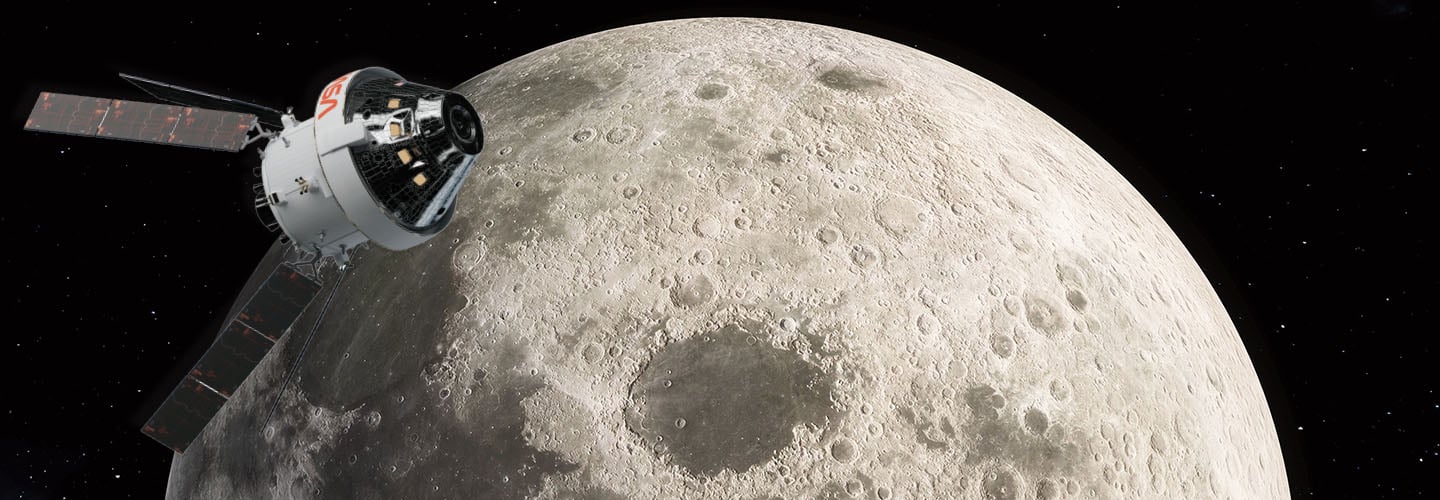

The Orion spacecraft

NASA (Orion); Shutterstock.com (moon)

Standards

Blast Off!

A new moon mission could send astronauts farther into space than ever before.

As You Read, Think About: What are the main goals of the Artemis II mission?

What You Need to Know About the Moon
Watch a video tour of Earth’s closest neighbor.

Christina Koch is getting ready for an amazing trip. She and three other astronauts will journey more than 230,000 miles from Earth. They’ll zoom around the moon and back at speeds of up to 25,000 miles per hour. The crew will fly closer to the moon than anyone has in more than 50 years!

The 10-day mission is known as Artemis II. It could happen as soon as February. NASA, the U.S. space agency, says this is a big step toward another goal. Next year, it plans to land humans on the moon for the first time since 1972.

Christina Koch is getting ready for an amazing trip. She and three other astronauts will travel more than 230,000 miles from Earth. They will zoom around the moon and back. They’ll reach speeds of up to 25,000 miles per hour. The crew will fly closer to the moon than anyone has in more than 50 years!

The 10-day mission is called Artemis II. It could happen as soon as February. NASA, the U.S. space agency, says this is a big step toward another goal. Next year, it plans to land humans on the moon. That hasn’t happened since 1972.

ROBERT MARKOWITZ NASA-JSC

The Artemis II crew (clockwise from top left): Victor Glover, Jeremy Hansen, Christina Koch, and Reid Wiseman

But NASA isn’t ready for astronauts to walk on the lunar surface just yet. First it has to make sure it can get them there and back safely.

That’s where the Artemis II crew comes in. They will fly around the moon in a spacecraft called Orion (above). They will make sure it works properly.

The crew will go thousands of miles past the far side of the moon. That’s the side we can’t see from Earth.

“We could see parts of the moon that never have had human eyes lay upon them before,” Koch says.

But NASA isn’t ready for astronauts to walk on the lunar surface yet. First it has to make sure astronauts can get there and come back safely.

That’s where the Artemis II crew comes in. They will fly around the moon in a spacecraft. It’s called Orion (above). They will make sure Orion works properly.

The crew will go thousands of miles past the far side of the moon. That’s the side we can’t see from Earth.

“We could see parts of the moon that never have had human eyes lay upon them before,” Koch says.

Mission Path

The crew will travel about 685,000 miles around the moon and back.

The crew will travel about 685,000 miles around the moon and back.

Shutterstock.com

1. Launch from Florida

2. Circle Earth twice

3. Travel to the moon

4. Go more than 4,500 miles past the moon

5. Fly back to Earth

6. Splash down in the Pacific Ocean

1. Launch from Florida

2. Circle Earth twice

3. Travel to the moon

4. Go more than 4,500 miles past the moon

5. Fly back to Earth

6. Splash down in the Pacific Ocean

More to Explore

From 1969 to 1972, 12 American men walked on the moon. The astronauts were part of NASA’s Apollo program. They collected rocks and soil that scientists still study today. Since then, only small robots called rovers have explored the moon.

The Artemis program was created to send astronauts back to the moon. It’s part of an even larger plan. In the future, NASA wants to send humans farther into space. Scientists from the U.S. and other countries are building a space station called Gateway. It could one day orbit the moon. Astronauts could stop there on their way to Mars!

From 1969 to 1972, 12 American men walked on the moon. The astronauts were part of NASA’s Apollo program. They collected rocks and soil. Scientists still study these today. Since 1972, only small robots called rovers have explored the moon.

The Artemis program was created to send people back to the moon. It’s part of an even larger plan. In the future, NASA wants to send humans farther into space. Scientists from the U.S. and other countries are building a space station. It’s called Gateway. It could one day orbit the moon. Astronauts could stop there on their way to Mars!

NASA/Mark Sowa 

The crew has spent a lot of time getting used to the tight space in the Orion spacecraft.

An Important Step

The first Artemis mission launched in 2022. Over 26 days, Orion flew around the moon and back. No one was on board. The mission proved the spacecraft could survive the trip. Now it’s time for a human test flight.

A rocket carrying Orion will take off from Florida. A few minutes later, Orion will separate from the main rocket. It will head toward the moon. The crew will remain inside Orion during the entire mission. They will be in touch with NASA to report any problems.

The first Artemis mission launched in 2022. It took 26 days. Orion flew around the moon and back. No one was on board. The mission showed that the spacecraft could make the trip. Now it’s time for a human test flight.

A rocket carrying Orion will take off from Florida. A few minutes later, Orion will break off from the main rocket. It will head toward the moon.

The crew will be inside Orion during the whole mission. They will be in touch with NASA to report any issues.

Pause and Think

How might the crew prepare for such an important mission?

How might the crew prepare for such an important mission?

Back to the Moon

The Artemis II crew has been training since June 2023. They’ve simulated every part of their trip. NASA will use what the crew learns to get ready for the next mission. In 2027, humans could land on the moon during Artemis III.

“We like to think that our true mission isn’t fulfilled until we see someone walking on the moon,” says Koch. “That’s when we know we did our job.”

The Artemis II crew has been training since June 2023. They have simulated every part of the trip. NASA will use what the crew learns to prepare for the next mission. In 2027, humans could land on the moon during Artemis III.

“We like to think that our true mission isn’t fulfilled until we see someone walking on the moon,” says Koch. “That’s when we know we did our job.”

NASA/Bill Ingalls 

After circling the moon, the crew will splash down in the Pacific Ocean. They practiced being picked up by the U.S. Navy.

All About the Moon

Scientists think the moon formed more than 4 billion years ago. A small planet smashed into Earth, sending fiery bits of rock into space. The materials stuck together and formed the moon! Read on for more.

Scientists think the moon formed more than 4 billion years ago. A small planet smashed into Earth, sending fiery bits of rock into space. The materials stuck together and formed the moon! Read on for more.

Shutterstock.com 

Waterless Seas: People once thought the moon’s dark spots were seas. We now know they were pools of lava that eventually froze.

Waterless Seas: People once thought the moon’s dark spots were seas. We now know they were pools of lava that eventually froze.

Shutterstock.com 

Crash Course: The moon’s surface is covered with holes called craters. They were formed by space rocks smashing into the moon.

Crash Course: The moon’s surface is covered with holes called craters. They were formed by space rocks smashing into the moon.

Apic/Getty Images 

Buzz Aldrin on the moon in 1969

Watch Your Step! There is no wind or rain on the moon. That means footprints left by astronauts more than 50 years ago are still there!

Watch Your Step! There is no wind or rain on the moon. That means footprints left by astronauts more than 50 years ago are still there!

1. What did NASA accomplish with the Apollo program?

2. What are the main goals of the Artemis II mission?

3. What is one fact from the sidebar “All About the Moon” that you think is interesting or surprising? Explain.

1. What did NASA accomplish with the Apollo program?

2. What are the main goals of the Artemis II mission?

3. What is one fact from the sidebar “All About the Moon” that you think is interesting or surprising? Explain.

videos (2)
videos (2)
Skills Sheets (3)
Skills Sheets (3)
Skills Sheets (3)
Games (1)
TEACHER SUPPORT (1)
Leveled Articles (1)
Text-to-Speech